In the realm of trigonometry, understanding the relationships between the angles and sides of triangles is fundamental. The Sum and Difference Identities are essential tools that allow us to manipulate and simplify trigonometric expressions, especially when dealing with compound angles. These identities are invaluable for both theoretical exploration and practical applications in various fields, including engineering, physics, and computer science. This article aims to delve into these identities, providing a comprehensive guide to their usage, applications, and real-world significance.
Unraveling the Sum and Difference Identities
The Sum and Difference Identities, often simply referred to as the angle addition formulas, are a set of trigonometric identities that allow us to find the trigonometric functions of the sum or difference of two angles. These identities are derived from the basic definitions of trigonometric functions and the geometric properties of triangles. They provide a means to break down complex angles into simpler ones, making trigonometric calculations more manageable.
The Sum Identities
The Sum Identities, also known as the angle addition formulas, allow us to find the trigonometric functions of the sum of two angles. For instance, if we have two angles α and β, the Sum Identities can be expressed as follows:
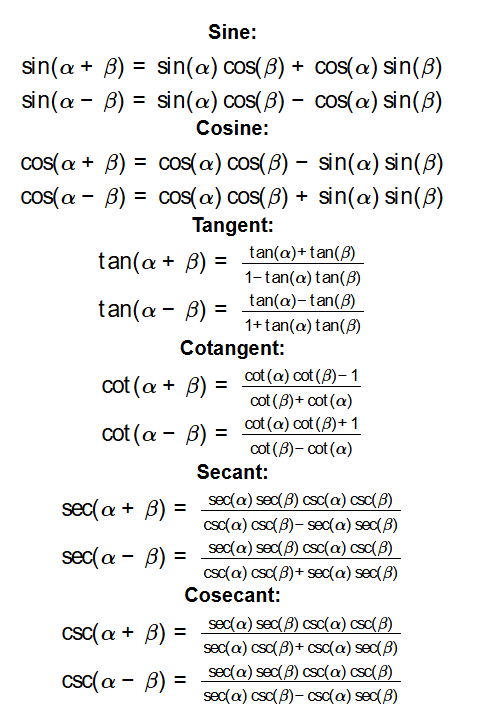
- sin(α + β) = sin α * cos β + cos α * sin β
- cos(α + β) = cos α * cos β - sin α * sin β
- tan(α + β) = [tan α + tan β] / [1 - tan α * tan β]
These identities provide a way to calculate the trigonometric functions of a sum of angles, which is particularly useful when dealing with compound angles in various mathematical and scientific problems.
The Difference Identities
Complementary to the Sum Identities, the Difference Identities allow us to find the trigonometric functions of the difference between two angles. For angles α and β, the Difference Identities are:
- sin(α - β) = sin α * cos β - cos α * sin β
- cos(α - β) = cos α * cos β + sin α * sin β
- tan(α - β) = [tan α - tan β] / [1 + tan α * tan β]
These identities are especially handy when dealing with angles that have a difference in their measurements, a common occurrence in fields like physics and engineering.
Applications and Practical Usage
The Sum and Difference Identities find applications in a myriad of fields and scenarios. Here's a glimpse into some practical uses:
Physics and Engineering
In physics, these identities are indispensable for calculating angles and distances in wave propagation, particularly in optics and acoustics. Engineers rely on these identities for tasks like determining the angles of incidence and reflection in optics, or analyzing the behavior of waves in different media.
Computer Graphics and Animation
The Sum and Difference Identities are fundamental in computer graphics and animation. They are used to calculate the angles and rotations of objects, allowing for realistic animations and special effects. For instance, in video game development, these identities are crucial for creating fluid and lifelike character movements.
Electrical Engineering and Signal Processing
In electrical engineering, the identities are applied to analyze and manipulate signals, especially in the context of phasors and complex numbers. Signal processing, a critical aspect of modern communication systems, heavily relies on these identities to manipulate and transform signals.
Mechanical Engineering
Mechanical engineers use these identities to calculate angles and rotations in complex mechanical systems. For instance, in the design of robotics and automation systems, understanding the Sum and Difference Identities is vital for precise control and movement.
Real-World Examples
Let's explore a couple of real-world scenarios where the Sum and Difference Identities are put into action:
Optical Systems
In an optical system, such as a telescope or a camera, light enters through an aperture and is focused onto a sensor or a film. The angle at which the light enters, known as the angle of incidence, is critical for the quality of the image. Using the Sum Identities, engineers can calculate the angle of incidence for a given aperture size and distance, ensuring optimal image quality.
Robotic Arm Control
Consider a robotic arm with multiple joints, each having a specific angle of rotation. To control the arm's movement and position accurately, engineers use the Difference Identities. By calculating the difference between the desired angle and the current angle at each joint, the robot can make precise adjustments, ensuring efficient and safe operation.
Calculator Usage and Benefits
While a deep understanding of the Sum and Difference Identities is crucial, calculators and online tools can be invaluable aids in performing quick calculations. A Sum and Difference Identities Calculator, such as the one available at [Calculator Website], can simplify complex trigonometric expressions, saving time and reducing the risk of errors. These calculators are particularly useful for students, engineers, and researchers, offering a quick and reliable way to verify results and explore mathematical concepts.
Features and Benefits of the Calculator
- User-Friendly Interface: The calculator provides an intuitive interface, making it accessible to users of all skill levels.
- Instant Results: With just a few clicks, users can obtain accurate results, allowing for efficient problem-solving.
- Visual Representation: Some calculators offer visual aids, providing a clearer understanding of the concepts.
- Error Prevention: By automating the calculations, these calculators reduce the chances of human errors.
- Accessibility: Online calculators can be accessed from anywhere with an internet connection, offering convenience and flexibility.
Using a calculator for Sum and Difference Identities can be a great learning tool, allowing users to explore different scenarios and understand the practical applications of these identities.
Conclusion: Embracing the Power of Trigonometric Identities

The Sum and Difference Identities are powerful tools that extend our understanding and manipulation of trigonometric functions. By unraveling the relationships between angles and trigonometric functions, these identities provide a bridge between theoretical concepts and real-world applications. Whether in physics, engineering, or computer science, these identities play a pivotal role in problem-solving and innovation.
As we continue to explore and apply these identities, we unlock new possibilities and deepen our understanding of the world around us. The Sum and Difference Identities are a testament to the beauty and practicality of mathematics, serving as a foundation for countless discoveries and advancements.
How are the Sum and Difference Identities derived?
+The Sum and Difference Identities are derived from the basic definitions of trigonometric functions and the geometric properties of triangles. They are a result of manipulating the trigonometric functions of the angles in a right triangle to find the functions of the sum or difference of those angles.
What are the practical applications of the Sum and Difference Identities?
+These identities find applications in various fields, including physics, engineering, computer graphics, and signal processing. They are used to calculate angles and rotations, analyze wave propagation, and manipulate signals. In essence, they provide a way to break down complex angles into simpler ones, making calculations more manageable.
How can I use a Sum and Difference Identities Calculator effectively?
+A Sum and Difference Identities Calculator is a tool that simplifies complex trigonometric expressions. To use it effectively, enter the angles or functions you wish to calculate, and the calculator will provide the results instantly. It’s a great way to verify calculations and explore different scenarios, aiding in problem-solving and understanding.
