The Fascinating Journey of Counting Backwards: Unlocking the Secrets of Base-10 Arithmetic

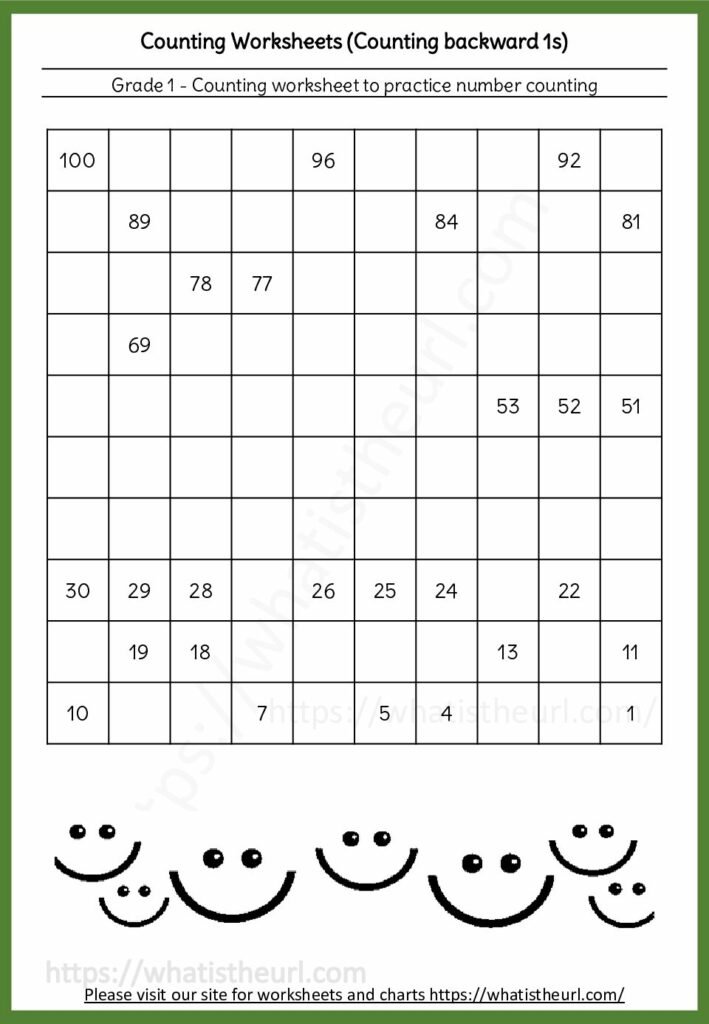
Counting backwards is an intriguing concept that offers a unique perspective on the fundamental nature of numbers. While forward counting is a familiar and intuitive process, counting backwards unveils the hidden patterns and structures within our numerical system. In this comprehensive guide, we will delve into the process of counting from 100 backwards by 7, exploring the mathematical principles, historical context, and practical applications of this seemingly simple yet captivating task.
To embark on our journey, let's first establish the basic understanding of counting backwards. In the base-10 numerical system, which is the standard system we use daily, counting backwards involves subtracting a fixed value from each subsequent number. In our case, we are counting backwards from 100 by 7, which means we subtract 7 from each number as we descend the numerical sequence.
The Mathematical Foundations
Mathematically, counting backwards can be expressed as a simple subtraction equation. When we count from 100 backwards by 7, we are essentially subtracting 7 from 100, then subtracting 7 from the result, and so on. This can be represented as:
100 - 7 = 93
93 - 7 = 86
86 - 7 = 79
... and so on ...
This process continues until we reach a number that cannot be subtracted by 7 without yielding a negative result. In our case, the sequence ends at 3, as subtracting 7 from 3 would give us a negative number, which is outside the natural number set.
Historical Perspective
The concept of counting backwards has a rich historical background, dating back to ancient civilizations. Early mathematicians and scholars recognized the value of counting backwards as a tool for understanding the relationships between numbers and for solving complex problems. For instance, the ancient Babylonians used a base-60 numerical system, which allowed them to perform intricate calculations, including counting backwards, with remarkable precision.
In more recent history, counting backwards has played a significant role in various fields. For example, in astronomy, counting backwards from a specific date was essential for predicting celestial events and calculating planetary positions. Similarly, in finance and economics, counting backwards is used to calculate interest rates, amortization schedules, and other time-value-of-money concepts.
Practical Applications
Counting backwards from 100 by 7 may seem like a straightforward task, but it has numerous practical applications in everyday life. Here are a few examples:
- Time Management: Counting backwards can be a useful tool for time management. For instance, if you have 100 minutes to complete a task and you want to ensure an even distribution of time, you can count backwards by 7 to break the task into manageable segments.
- Project Planning: In project management, counting backwards is often used to create a timeline or schedule. By starting with a deadline (e.g., 100 days) and counting backwards by a fixed interval (e.g., 7 days), you can determine key milestones and ensure the project progresses smoothly.
- Financial Planning: When creating a budget or saving for a goal, counting backwards can help you set realistic targets. For example, if you want to save $100 per week, counting backwards by $7 can help you understand how long it will take to reach your goal and plan your savings strategy accordingly.
Furthermore, counting backwards is an essential skill in various fields, including mathematics, computer science, and even sports. In mathematics, it is used to solve equations and perform calculations. In computer science, counting backwards is fundamental to understanding binary and hexadecimal number systems. In sports, counting backwards is often used in training routines and interval workouts to measure performance and intensity.
The Benefits of Counting Backwards
Counting backwards offers several benefits beyond its practical applications. Firstly, it enhances our numerical literacy and understanding of mathematical concepts. By engaging with numbers in a different way, we develop a deeper appreciation for the relationships and patterns that exist within the numerical system.
Secondly, counting backwards improves our cognitive abilities. It requires focus, concentration, and mental agility, which can enhance our overall brain function. Regular practice of counting backwards can improve our memory, problem-solving skills, and even our ability to process information quickly.
Lastly, counting backwards can be a fun and engaging activity, especially for children. It provides an interactive way to learn about numbers and can be incorporated into educational games and activities to make learning more enjoyable and effective.
Advanced Techniques and Variations
While counting backwards from 100 by 7 is a basic example, there are numerous variations and advanced techniques that can be explored. Here are a few:
- Variable Counting: Instead of counting backwards by a fixed number, you can vary the subtraction value. For instance, you could count from 100 backwards by alternating between 7 and 3, or by using a random number generator to choose the subtraction value each time.
- Pattern Recognition: Look for patterns that emerge when counting backwards. For example, when counting backwards from 100 by 7, you may notice that the last digit repeats in a cycle of 3, 6, 9, and then starts over. Recognizing and understanding these patterns can lead to fascinating mathematical discoveries.
- Complex Counting: Explore more complex counting sequences, such as counting backwards by prime numbers or counting backwards by a specific number that increases or decreases with each step. These variations can provide a challenging mental workout and deepen your understanding of numbers.
Additionally, counting backwards can be applied to different number systems, such as binary, hexadecimal, or even Roman numerals. By adapting the counting process to these alternative systems, you can gain a deeper understanding of their unique characteristics and applications.
Conclusion
Counting backwards from 100 by 7 is more than just a simple mathematical exercise. It is a journey into the heart of numerical understanding, revealing the intricate relationships and patterns that exist within our number system. From its historical roots to its practical applications, counting backwards offers a fascinating glimpse into the world of mathematics and its impact on various fields.
By embracing the concept of counting backwards, we can enhance our numerical literacy, improve our cognitive abilities, and discover the beauty and complexity of numbers. So, the next time you find yourself counting backwards, remember that you are engaging in a timeless practice with profound implications.
💡 Counting backwards is not just a mathematical exercise; it's a powerful tool for understanding numbers and their relationships. By exploring the concept further, we can unlock a wealth of knowledge and enhance our mathematical abilities.
Can counting backwards be applied to other number systems, like binary or hexadecimal?
+Absolutely! Counting backwards can be adapted to different number systems, providing a unique perspective on their characteristics and applications. For example, counting backwards in binary or hexadecimal can reveal interesting patterns and help deepen your understanding of these number systems.
Are there any online tools or resources to assist with counting backwards?
+Yes, there are various online calculators and number-counting tools available that can assist with counting backwards. These tools can help you explore different counting sequences and variations, making the process more interactive and engaging.
How can counting backwards improve my mathematical skills?
+Counting backwards enhances your mathematical skills by challenging your numerical understanding and cognitive abilities. It requires focus, concentration, and problem-solving skills, all of which contribute to a deeper grasp of mathematical concepts and improved overall mathematical proficiency.
